For confidentiality reasons, this page only describes the mechanisms and architecture that were put in place. It does not mention the tool's name or its data.
Stack: Kotlin, Spring Boot, PostgreSQL, React, LangChain4j.
Context
- Internal career management platform, developed within an agile team.
- Goal of the redesign: add new processes, statistics and an AI assistant, and steer the user journey towards action rather than simply viewing data.
- My role: leading the redesign project and full-stack development.
Actions
Intern follow-up
- End-to-end design of a new type of review meeting: workflow, state machine and permission management.
- Automatic scheduling of review meetings.
AI assistant
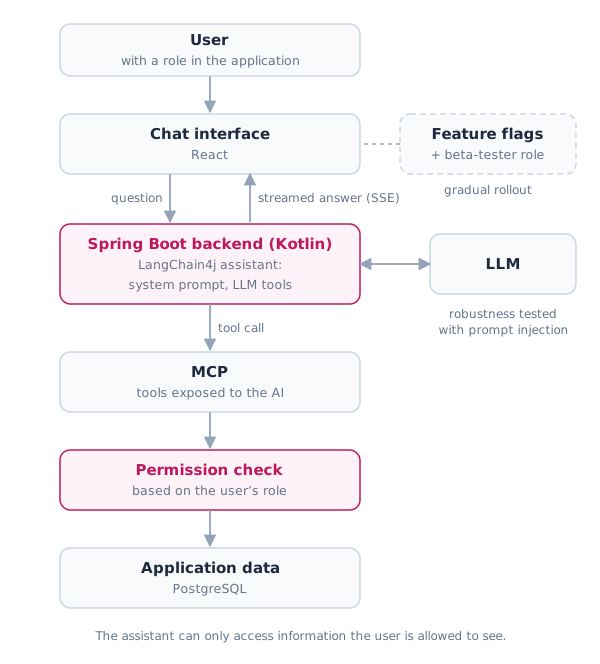
- AI chat able to retrieve information from the application through an MCP (Model Context Protocol), built with LangChain4j.
- AI permissions aligned with the user's role: the assistant can only access what the user is allowed to see.
- Robustness testing with prompt injection.
- Gradual rollout to users through feature flags and a beta-tester role.
Data migration
Four-step migration from a legacy model to a new table, including migration of historical data and handling of edge cases.
Performance
- Removal of N+1 queries.
- Measured gains in the number of queries, loading time and volume of data exchanged.
Google Drive synchronisation
- Scripts synchronising the application with the Google Drive API.
- Document permissions updated according to the assigned manager.
UX/UI redesign
- User journey redesigned to make the platform action-oriented rather than focused on viewing data.
Results
- Data migration completed with no service interruption.
- Improved performance, with measured gains in the number of queries, loading time and data exchanged.
- AI assistant gradually rolled out to beta-tester users.